Aliens

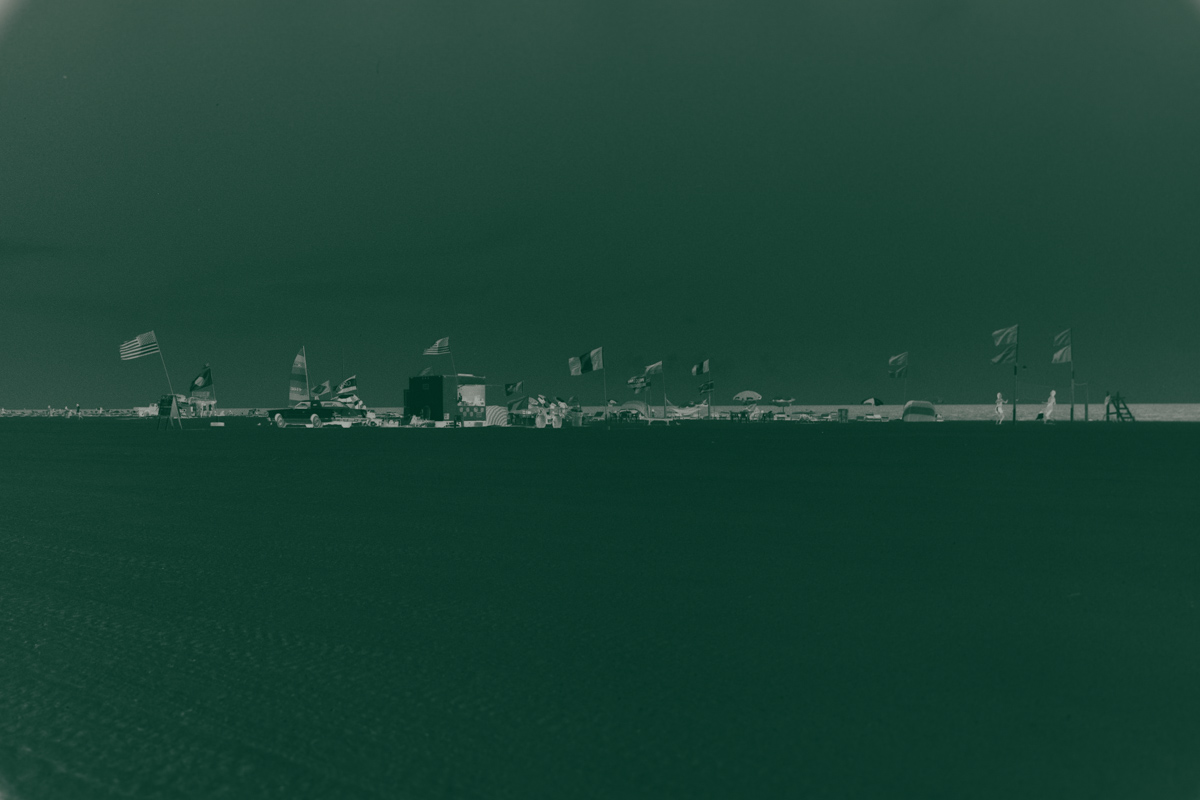
The image shows a person lying in bed holding a smartphone. Above them is a mirror mounted on the ceiling, inverting the view, so the room above the bed is visible in the reflection. The room contains various items such as a desk with a computer and chair, a microphone stand, a music stand, and other objects that may suggest musical or creative activity. It appears the person in bed is taking a selfie, with the photo captured via the mirror.

You can also recognise an object that probably looks like a bathroom scale, or is it simply a metal box with a rubber coating?

No, the thing, which also looks like an electric foot warmer from the DIY store, is actually a kind of spaceship that houses the secret centre of the world. All the strings are pulled from there. I have nothing to do with it, I just happen to be in the picture.

The last answer is humorous because it provides an absurd and imaginative interpretation of an everyday object. Instead of giving a simple explanation of what the object could be (like a bathroom scale or a box), it is described as a hidden spaceship that serves as a secret control centre for the world. This surprising twist plays on the idea of science fiction and conspiracy theories, making the answer witty and unexpected. The answerer’s self-distancing (“I have nothing to do with it, I just happen to be in the picture”) adds to the humorous effect by taking an innocent position in an obviously contrived and exaggerated situation.


Continue reading “Aliens”
Clarity and cruelty belong together

Was Baudrillard 1976 gesagt hat erinnert mich an Trump: “Wenn wir noch immer – vor allem heute – dem Traum von einer Welt eindeutiger Zeichen, einer starken „symbolischen Ordnung“ nachhängen, sollten wir uns keine Illusionen machen: es hat diese Ordnung gegeben, und zwar in einer unbarmherzigen Hierarchie, denn die Klarheit und die Grausamkeit der Zeichen gehören zusammen.” Es erinnert mich nicht nur an Trump, es erinnert mich auch das, was von von manchen als “radikale Linke” bezeichnet wird. Ich würde die ganz Rechten und ganz Linken unter einem Begriff zusammenfassen: tendenziell monoperspektifisch.

Klarheit und Grausamkeit gehören zusammen

What Baudrillard said in 1976 reminds me of Trump: “If we still – especially today – pursue the dream of a world of unambiguous signs, of a strong “symbolic order”, we should have no illusions: this order has existed, and in a merciless hierarchy, because the clarity and cruelty of signs belong together.” Not only does it remind me of Trump, it also reminds me of what is labelled by some as the “radical left”. I would summarise the far right and the far left under one term: tendentially monoperspectival.

Translated with www.DeepL.com/Translator (free version)

The form is the real content

When I consider how my Korsakow films have been received, it seems to me that the subjects I1 have dealt with – the “stories I have told” – are rather secondary.

Books (and many texts) have been written about Korsakow. Although individual works, such as [The LoveStoryProject], have been repeatedly discussed (as in Sandra Gaudenzi’s PhD), the “actual” content of the works has rarely been at issue.

What seems to be unusual, and has been and is being discussed, is the form – the form in which certain Korsakow films are made, expressing an attitude (Haltung) not seemingly so evident in other forms of cinematic storytelling. It is, then, this form that seems to produce an attitude, at least in authors who engage with it. Not all authors who use Korsakow arrive equally at this attitude; many authors, according to my observation, “resist” the form; it seems to me that they work against the form, or as I put it earlier, brush Korsakow against the grain.

From my point of view, such projects fail and Adrian Miles also describes this when he talks about how many people don’t get Korsakow properly. I recommend to these people to use more linear formats and to avoid misunderstandings I would like to say here that this is also completely o.k. from my point of view. The attitude Korsakow affords is not “the right one” it is just a different one. In my opinion, both attitudes have advantages and disadvantages.

The form seems to be – at least with Korsakow – an essential content and I wonder if this is not true for other kinds of projects as well. Whether, for example, the themes of linear films are perhaps not as important as generally assumed, whether perhaps the form in which linear films are told has a greater influence on the thinking of those who make the film and those who receive the film. I deliberately choose the grammatical singular (“linear film”) here, although I am aware that there are many forms of linear film that can produce a wide range of different attitudes. My argument is that linear film has a range of possible attitudes, as does Korsakow, some of which overlap but some of which do not.


This part that does not overlap would be the part that afforded an attitude that linear film does not. This area interests me – fervently.

Because the attitude seems to me to form the view that one can take on something.


1 and authors with whom I collaborated

Was wir finden werden

Miami Beach

Alles Wissen, was in der Vergangenheit gesammelt wurde, ist wahr, wurde wahr oder deutete zumindest auch damals schon in die richtige Richtung. Die, in die es dann tatsächlich ging. Früheres Wissen kann vielleicht überholt sein, so wie ein langsameres Fahrzeug von einem schnelleren überholt werden kann, doch nur, wenn sie beide in die selbe Richtung fahren. Wissen kann, entgegen dem, was das Wort suggeriert, nicht “widerlegt” werden, in dem Sinne, dass es mit dem neuen Wissen nun in die gegengesetzte Richtung geht. Es geht immer weiter. Vielleicht, dass sich die Richtung des Weges ändert, den das Papierschiffchen auf seinem Weg den Bach hinab nimmt. Es ändert ständig die Richtung, doch immer geht es den Bach hinab und nie hinauf. Das Schiff kommt im Verlauf der Zeit an immer neue, ungesehene, unvorstellbarere Orte. Die Eindrücke, die diese Orte auf die Menschen auf dem Schiff hinterlassen, prägen das Denken. Das Wissen der Vergangenheit wies schon immer freundlich in unsere Richtung. So wie ein Kapitän der immer souverän das Papierschiffchen in die Richtung weisst, in die sich dann tatsächlich bewegt.

Sternenhimmel

Sterne über Gülitz

Ich schaue in den Himmel. Man hat ein neues Teleskop ins All geschossen. Es blickt, wie ich, ins Universum. Doch es sieht viel genauer. Ich sehe Sterne, das Teleskop sieht Galaxien. So viel Sterne am Himmel. So viele Galaxien wie ich Sterne sehen könnte, wenn ich mit einem Teleskop ins Universum blicken würde. Eine Galaxie sind Billionen Sterne. Es ist unvorstellbar. Scheinbar verstehbar nur, wenn man die Zahlen lediglich als Worte versteht.

Ich blicke zum Horizont. Ein Meer von Lichtern. So viele Lichter., so viele Menschen. Jeder Mensch ein Leben, ein Kopf, ein Denken so komplex wie meines. Jeder Mensch eine Galaxie von Gefühlen, Gedanken, Ideen, Erlebnissen, Erkentnissen. So wie man selbst eine Galaxie ist, von Gefühlen, Gedanken, Ideen, Erlebnissen, Erkentnissen. Scheinbar verstehbar nur wenn man es auf Worte reduziert.

Next page